Launch offer — valid today only

📄 Digital book in PDF · read it on your phone or print it

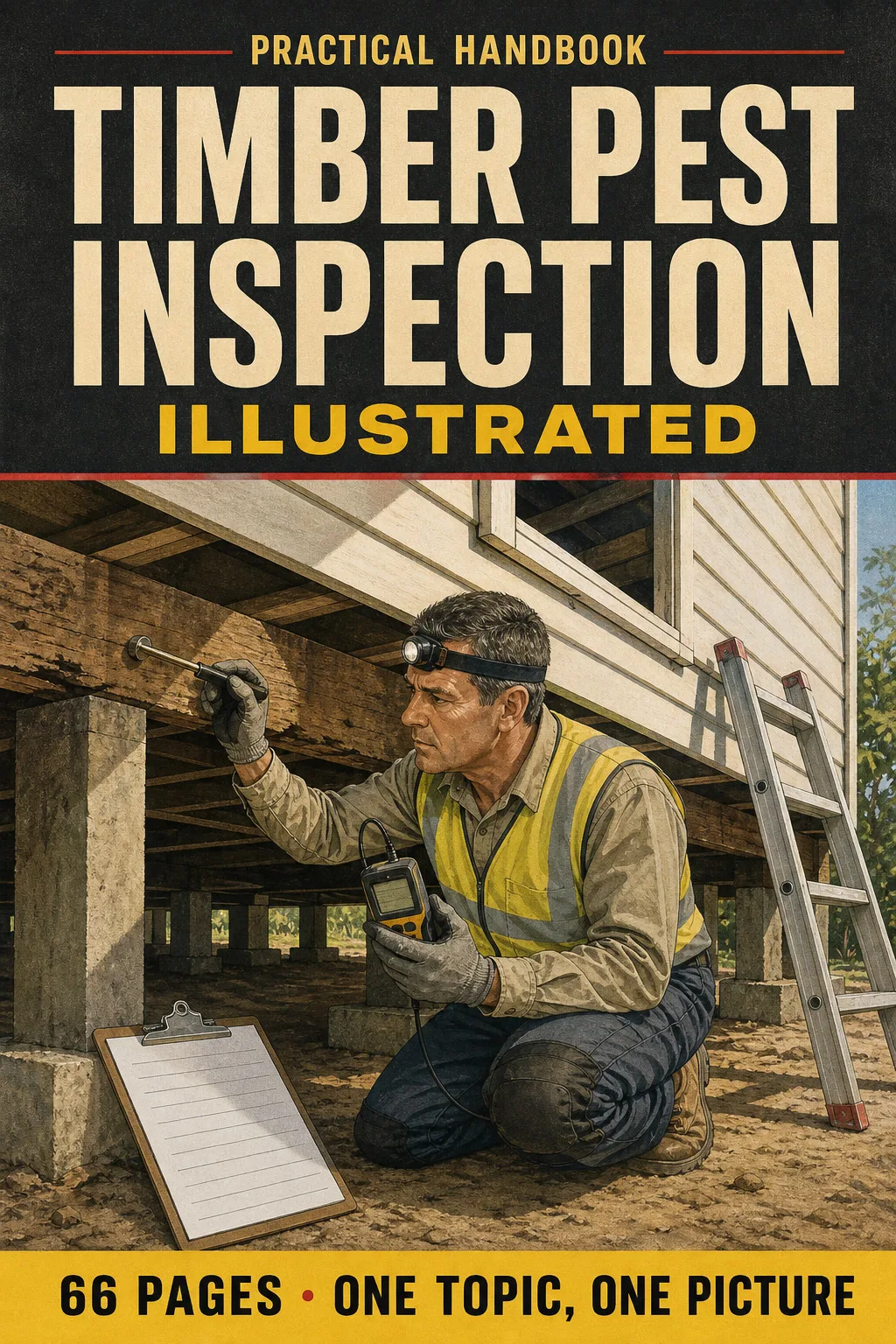
Timber Pest Inspection Illustrated One 5-Step Route on Every House, Written Up the AS 4349.3 Way

For timber pest inspections in NSW and Queensland, with Australian species: termite castes, mud leads, drywood pellets, lyctine and anobiid borers, fungal decay, moisture readings, ant caps, barrier bridging and the written report. One topic per page: the drawing first, then what you need to remember. 66 illustrated pages.

START STUDYING THIS WAY

🔒 Secure checkout · PDF by email · 30-day guarantee

Every topic, its own pageEach sign and each step drawn, with the explanation beside it
66 illustrated pages8 parts, from the four timber pests to the self-check before you sign
Up-to-date sourcesAS 4349.3, the AS 3660 series, and NSW EPA and Queensland Health guidance
PDF by emailFormat

Look Inside the Book

Every page has one big drawing and a box with the readings, signs and steps you need to know:

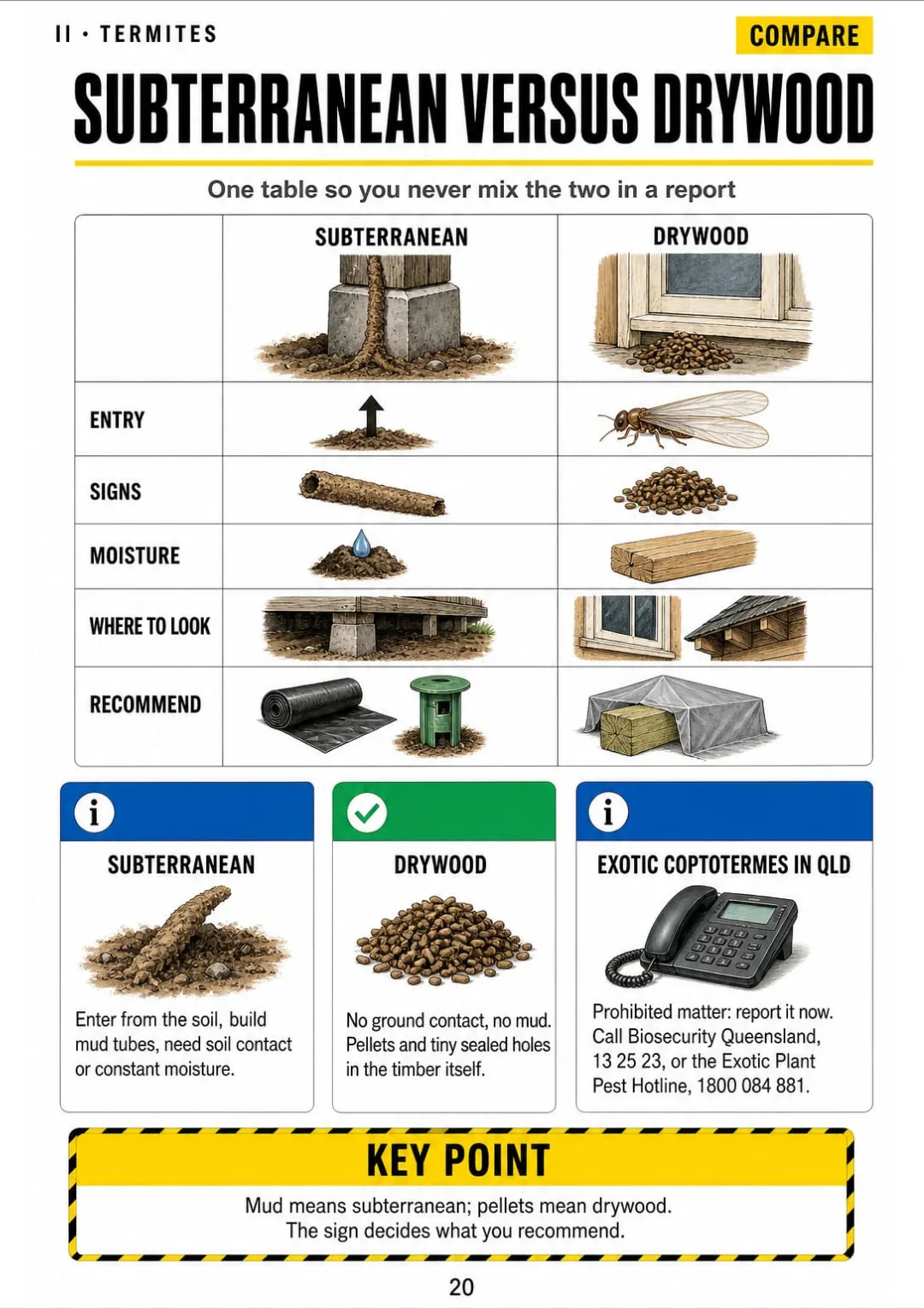
Subterranean leave mud and need soil; drywood leave pellets and need none
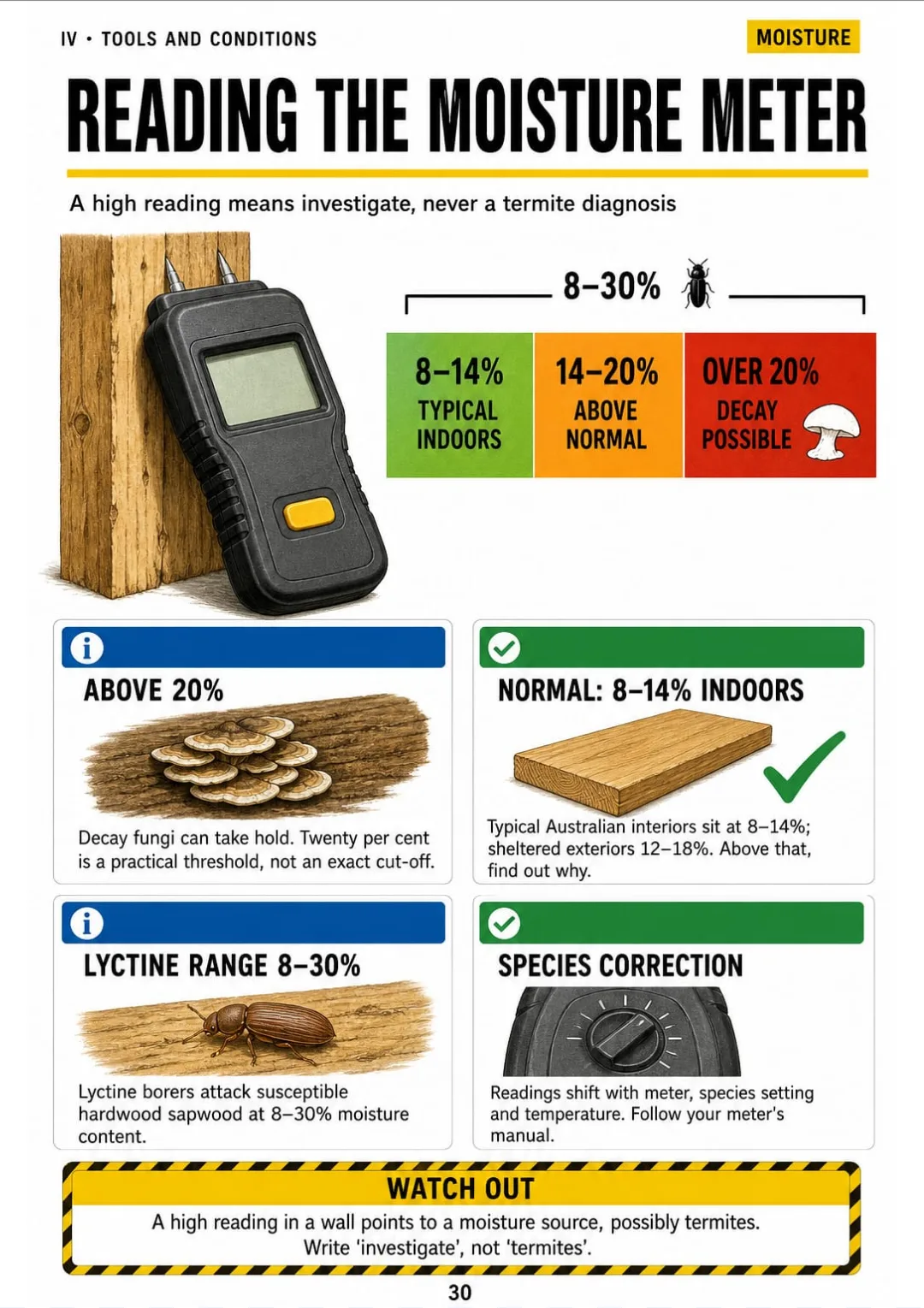
Indoors 8–14% is typical; above 20% decay is possible; lyctines at 8–30%.
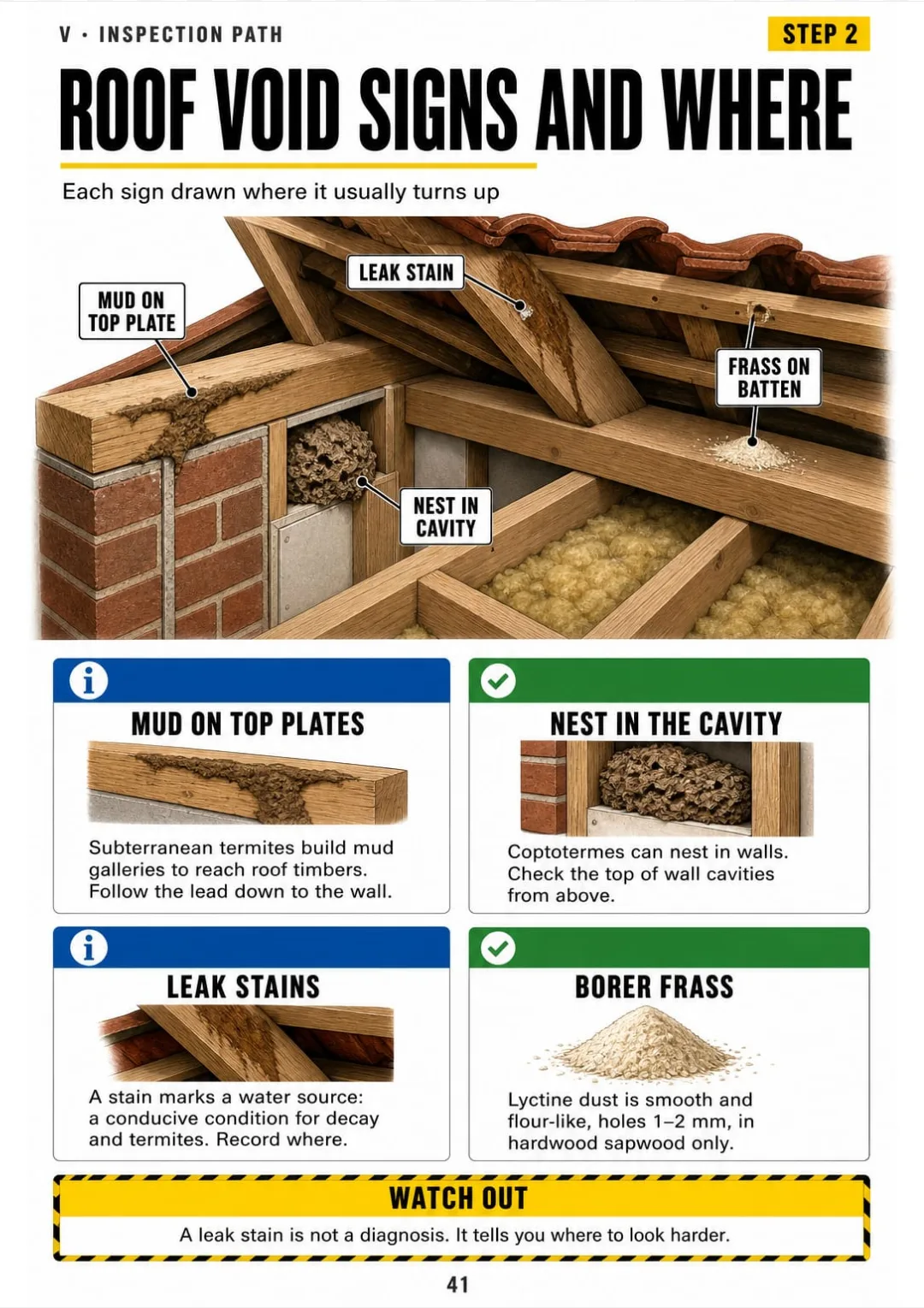
Roof void: mud on top plates, nests, leak stains, frass on battens
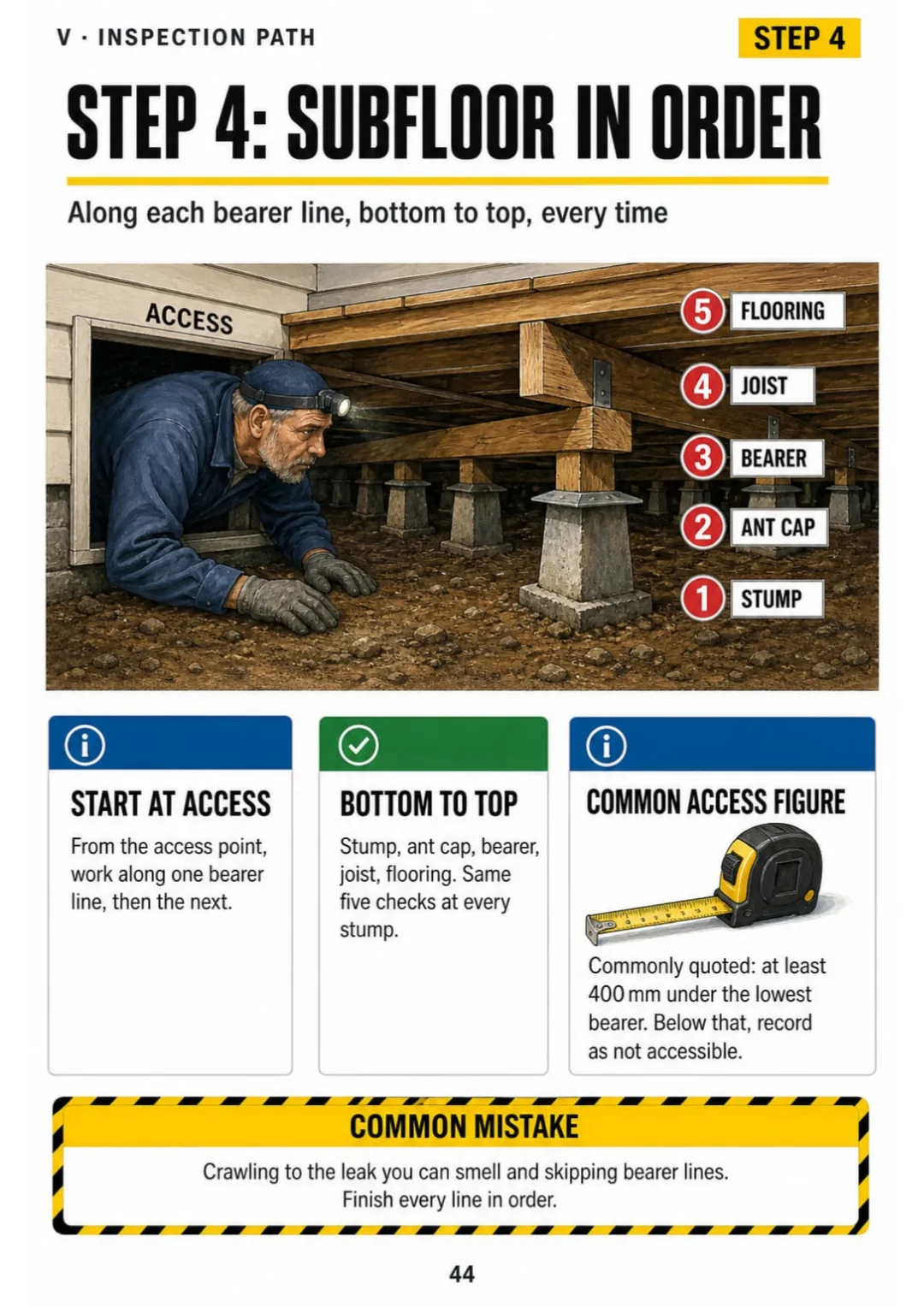
Subfloor order: stump, ant cap, bearer, joist, flooring along each bearer line
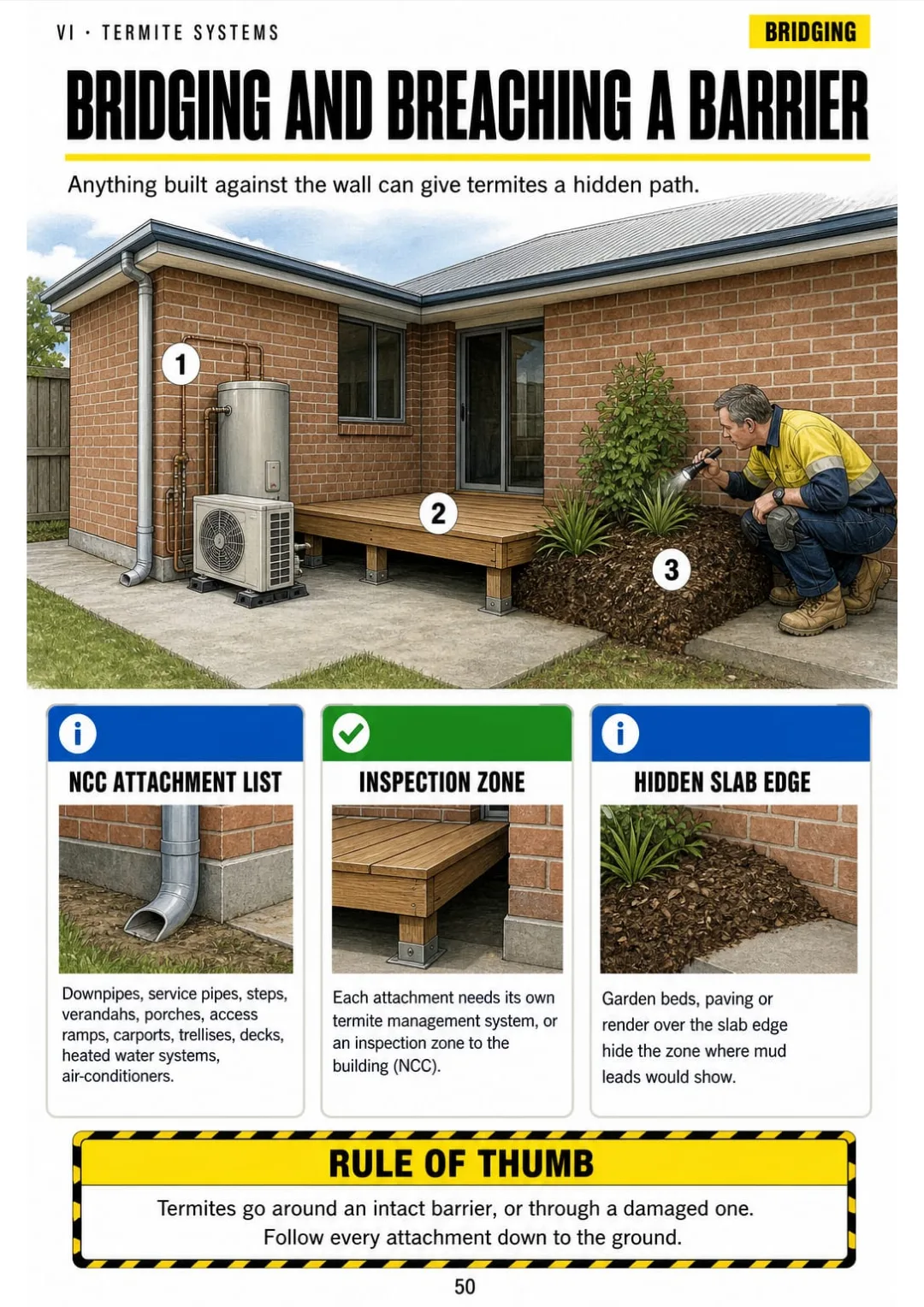
Common bridges around one house corner, in three numbered groups.
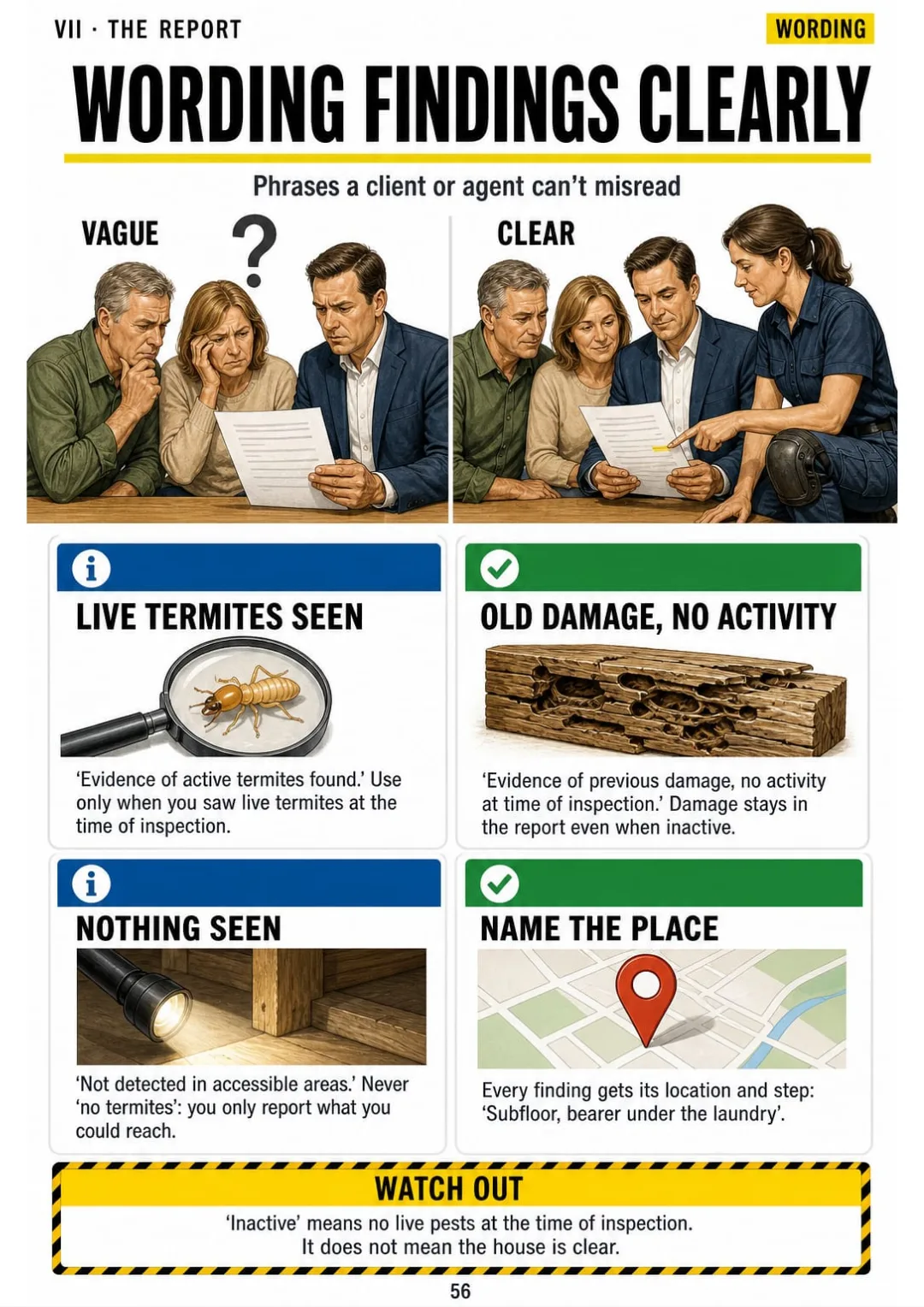
'Active', 'previous damage, no activity' and 'not detected in accessible areas': three phrases, three meanings.
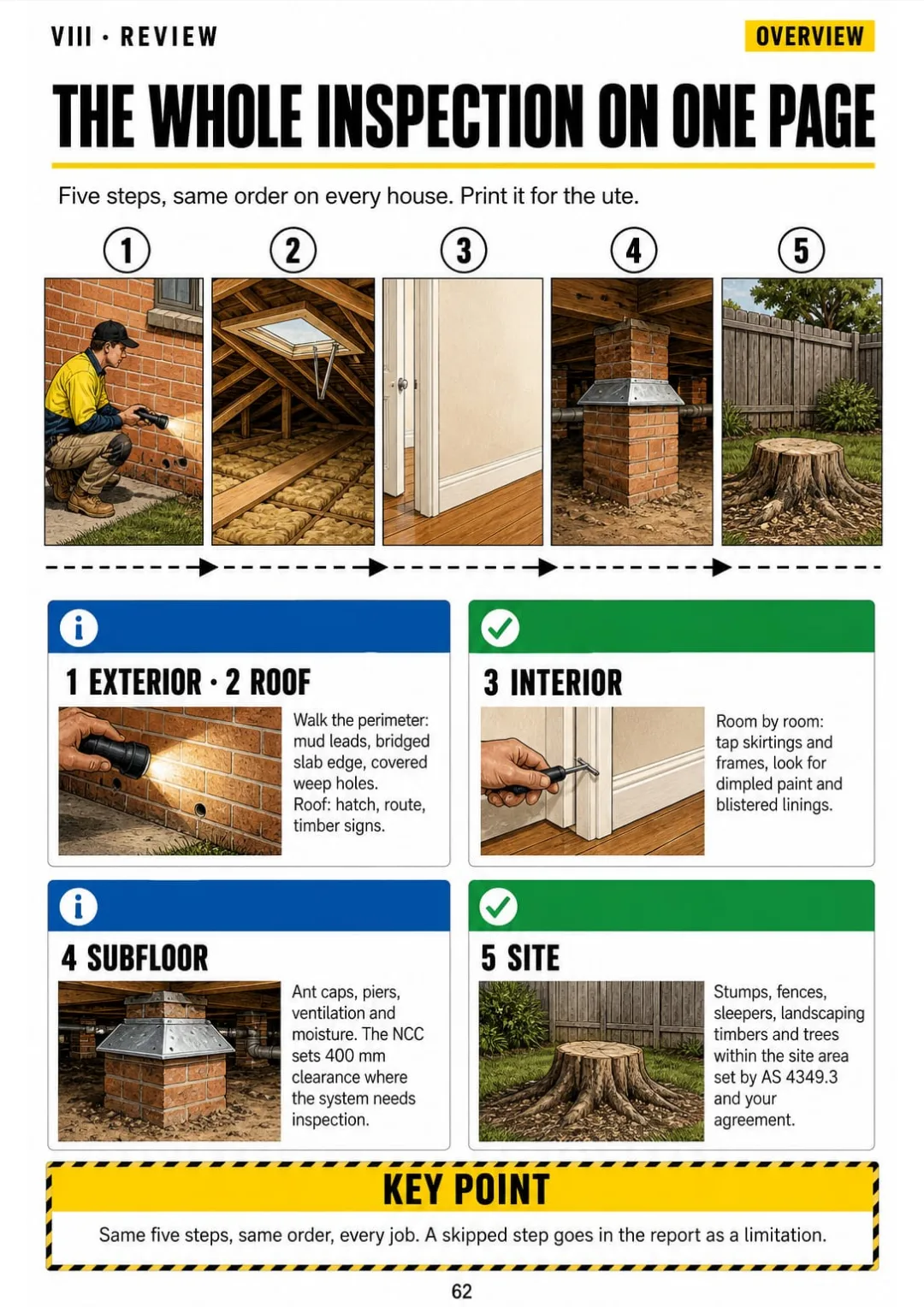
Exterior → roof void → interior → subfloor → site: the five-step path with the signs for each area.
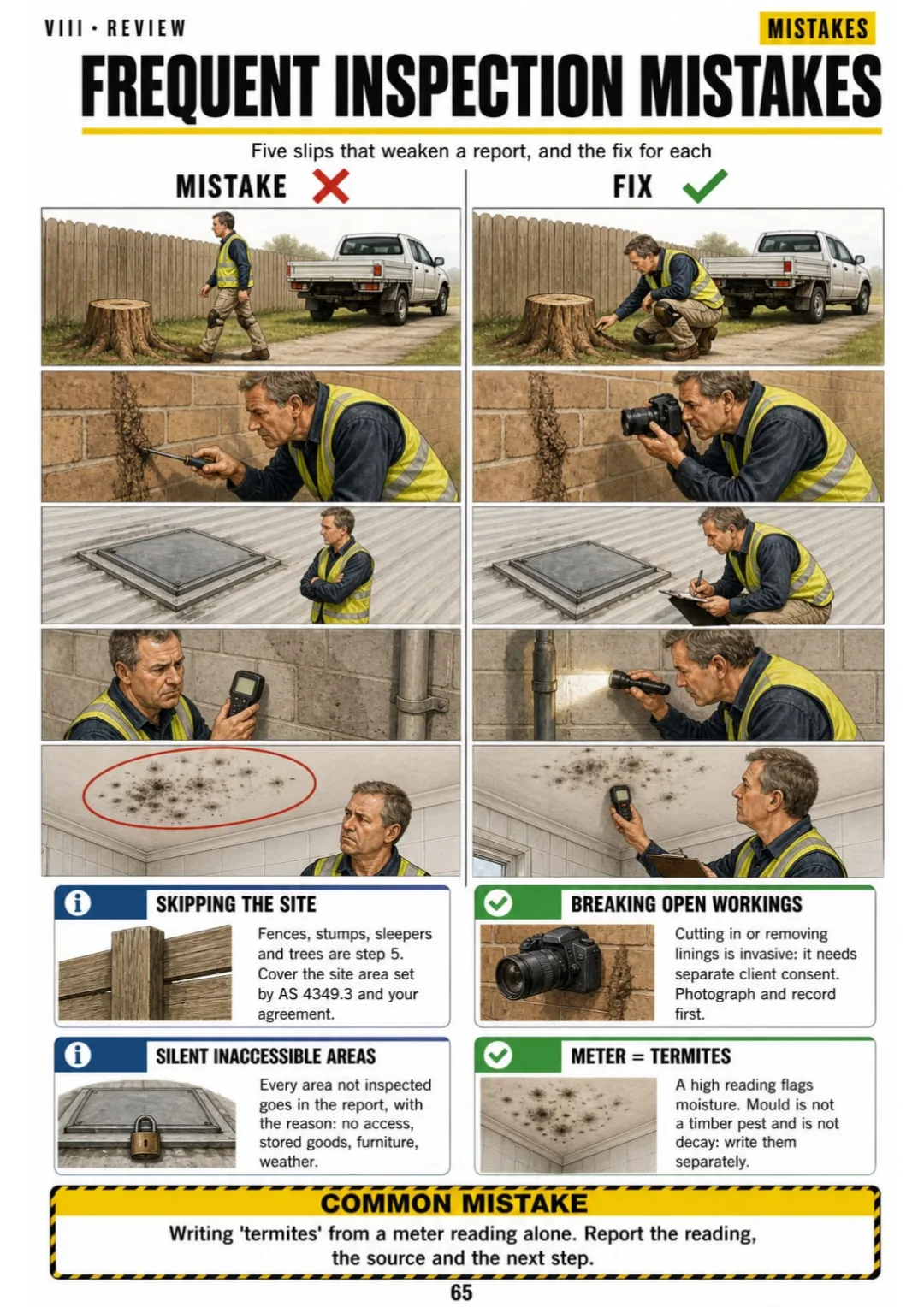
Skipped site, broken workings, unrecorded access limits, meter = termites, mould = decay: five frequent mistakes.

Swipe to see more →

These are real pages from the book. The table of contents is the full one: 8 parts and 62 topics.

The Problem Isn't You. It's How It Was Explained.

You're in the roof void on a hot afternoon. You've got the torch in one hand and you're balancing on the ceiling joists, and you have to decide where to look first.

The course notes put it all in one dense paragraph: top plates, nests, leak stains, frass, one after the other. Written like that, nothing tells you where to point the torch.

Roof void: mud on top plates, nests, leak stains, frass on battens

In the book, the roof void gets one page. The framing is drawn in section, with mud on the top plates, nests, leak stains and frass on the battens marked where they actually show up.

It's the same for the subfloor order, slab edges and weep holes, barrier bridging, moisture readings and report wording. Each one has its own page.

You climb in, follow the route you've seen drawn and note every sign without going back to the notes.

COMPARE FOR YOURSELF

The Same Topic, Two Ways to Study It

THIS
  • The manual: line after line
  • Moisture readings explained only in words
  • You get to the job still unsure
The moisture content of timber is expressed as a percentage of its oven-dry weight. In the field it is generally determined with a resistance-type or capacitance-type meter, and the readings must be corrected for species and temperature. Internal timbers in service typically reach equilibrium at between 8 and 14 per cent. Readings above 20 per cent may indicate conditions conducive to fungal decay, while lyctine borer attack has been associated with a range of approximately 8 to 30 per cent.
FOR THIS
  • The moisture meter in one drawing
  • The per cent ranges in a box
  • You see it and it makes sense
Indoors 8–14% is typical; above 20% decay is possible; lyctines at 8–30%.
CONTENTS

Take a Look at the 8 Parts and 62 Topics

What an inspection is, termites, borers and decay, tools and conducive conditions, the 5-step path, termite management systems, the report and a final review: 66 pages, all illustrated

IWhat a timber pest inspection is · pp. 5-10
  1. The four timber pests on one page
  2. What AS 4349.3 asks of you
  3. Visual inspection versus invasive inspection
  4. Reasonable access, drawn
  5. Who can inspect in NSW and Queensland
  6. Why the same path on every house
IISubterranean and drywood termites · pp. 11-20
  1. Inside the colony: castes in cross-section
  2. Why termites need mud and moisture
  3. Coptotermes: the main timber destroyer
  4. Schedorhinotermes and Nasutitermes
  5. Mastotermes in the tropical north
  6. Mud leads: working, abandoned and sealed
  7. Hollow-sounding timber: live or old damage?
  8. Alates and the flight season
  9. Drywood termites: pellets, not mud
  10. Subterranean versus drywood at a glance
IIIWood borers and fungal decay · pp. 21-28
  1. The borer life cycle
  2. Lyctine borers: sapwood of hardwoods
  3. Anobiid borers: furniture beetle and Queensland pine beetle
  4. European house borer
  5. Fungal decay: the four conditions
  6. Brown rot, white rot and soft rot
  7. Probing timber for decay
  8. Mould, sapstain and decay are not the same
IVTools and conducive conditions · pp. 29-35
  1. The basic kit
  2. Reading the moisture meter
  3. Thermal cameras and detection devices
  4. Conducive conditions: moisture
  5. Conducive conditions: timber and soil contact
  6. Trees, stumps and fences
  7. Your safety in the roof and subfloor
VThe 5-step inspection path · pp. 36-47
  1. Before you arrive: agreement and scope
  2. Step 1 · Exterior: walk the perimeter
  3. Slab edge and weep holes
  4. Step 1 · Decks, pergolas and external timbers
  5. Step 2 · Roof void: entry and route
  6. Step 2 · Roof void signs
  7. Step 3 · Interior: room by room
  8. Step 3 · Interior signs behind paint
  9. Step 4 · Subfloor: the order
  10. Step 4 · Ant caps and piers
  11. Step 4 · Subfloor ventilation and moisture
  12. Step 5 · The site: fences, stumps and trees
VITermite management systems · pp. 48-54
  1. Physical versus chemical barriers
  2. The durable notice
  3. Bridging and breaching a barrier
  4. Baiting and monitoring stations
  5. When to recommend a treatment
  6. How often to re-inspect
  7. Slab construction types and hidden entry
VIIWriting the report · pp. 55-61
  1. The report in four blocks
  2. Wording findings without overstating
  3. Rating the risk of timber pest attack
  4. Areas not inspected and limitations
  5. Recommendations that make sense
  6. Photos and site sketch
  7. Blank model report page
VIIIReview and frequent mistakes · pp. 62-66
  1. The whole inspection on one page
  2. Pest signs at a glance
  3. Moisture and risk cheat sheet
  4. Frequent inspection mistakes
  5. Self-check before you sign

One Page, One Topic, All Clear

Think of it this way:

You're under a house and the meter on a bearer reads well above twenty per cent. You need to know what that reading points to before you write it down.

You open the moisture meter page and the ranges are drawn in a box: 8–14% is typical indoors, above 20% decay is possible, and lyctines work in a band of their own.

Common bridges around one house corner, in three numbered groups.

It's the same for drywood pellets versus mud leads, ant caps on piers, the five barrier bridges at a house corner and the three phrases for findings: each one has its own page.

Timber Pest Inspection Illustrated is 8 parts and 62 topics, all drawn. It ends with the whole inspection on one page and a self-check before you sign.

What you see drawn, you don't have to memorize.

What's Inside Timber Pest Inspection Illustrated:

Ipp. 5-10

What a timber pest inspection is

Know what the job covers before you start: the four timber pests side by side, what AS 4349.3 asks of you, visual versus invasive inspection, reasonable access, and who can inspect in NSW and Queensland

IIpp. 11-20

Subterranean and drywood termites

The colony in cross-section, mud and moisture, Coptotermes, Schedorhinotermes, Nasutitermes and Mastotermes, mud leads, hollow-sounding timber, alates and drywood pellets

IIIpp. 21-28

Wood borers and fungal decay

The borer life cycle, lyctine and anobiid borers, European house borer, the four conditions for decay, the three rot types and probing timber

IVpp. 29-35

Tools and conducive conditions

The basic kit, reading the moisture meter, thermal cameras, conducive conditions, trees and stumps, and your safety in the roof and subfloor

Vpp. 36-47

The 5-step inspection path

Agreement and scope first, then the 5-step route you walk on every house: exterior with slab edge and weep holes, roof void, interior, subfloor with ant caps and piers, and the site, so nothing gets skipped

VIpp. 48-54

Termite management systems

Physical and chemical barriers, the durable notice, bridging and breaching, baiting stations, treatment, re-inspection and slab types

VIIpp. 55-61

Writing the report

The report in four blocks, wording findings, rating risk, limitations, recommendations, photos and site sketch, and a blank model page

VIIIpp. 62-66

Review and frequent mistakes

The whole inspection on one page, pest signs at a glance, a moisture and risk cheat sheet, frequent mistakes and a self-check

At the end of the book: The whole inspection on one page, a moisture and risk cheat sheet, a blank model report page and a self-check before you sign.
Plus: 2 Free Books

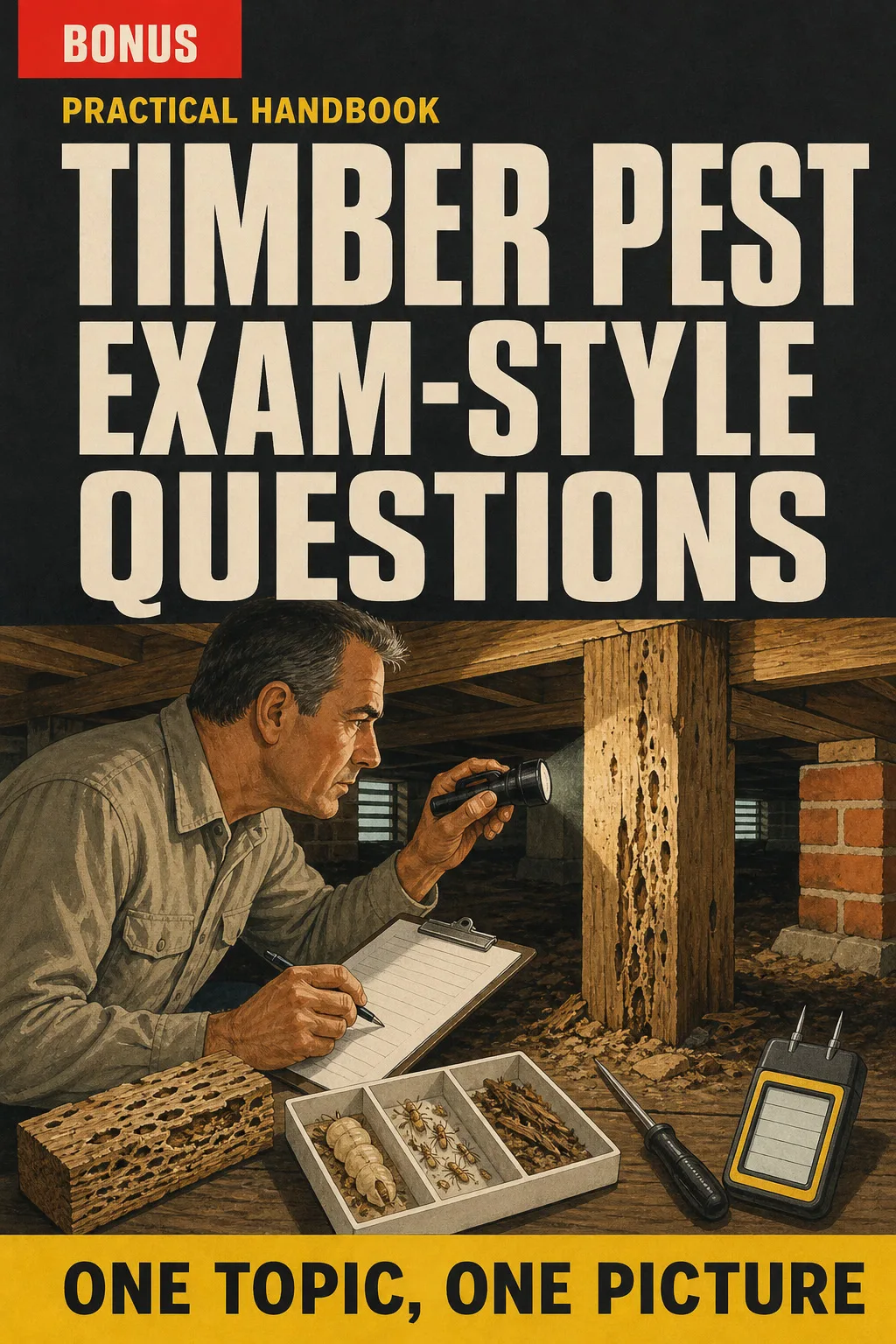
Timber Pest Exam-Style Questions

BONUS 1: «Timber Pest Exam-Style Questions»

Value on its own: US$ 17.90

Test yourself on termite signs, moisture readings, barriers and report limitations, with every answer explained, so you know what you know before the assessment.

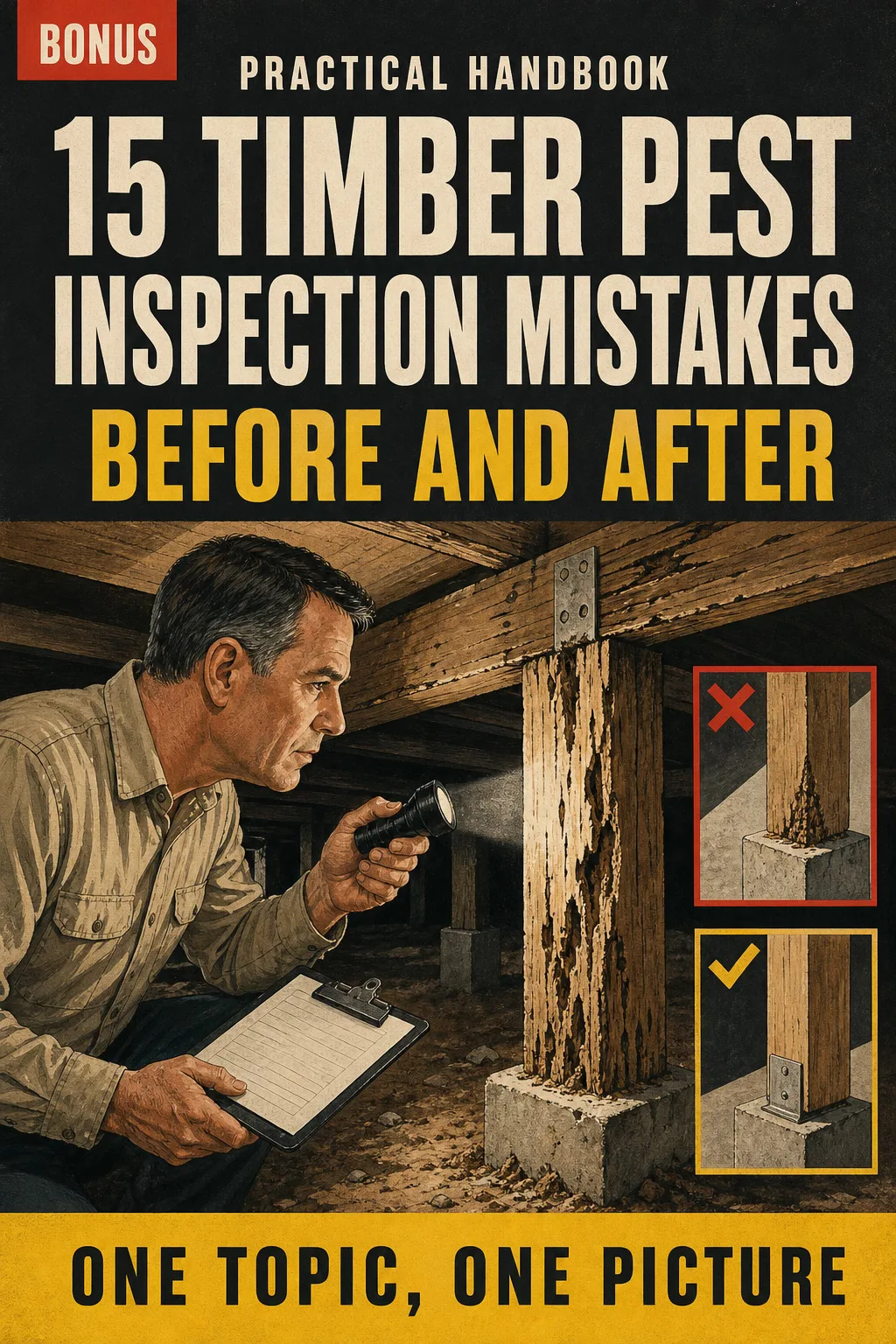
15 Timber Pest Inspection Mistakes: Before and After

BONUS 2: «15 Timber Pest Inspection Mistakes: Before and After»

Value on its own: US$ 14.90

See the most frequent inspection and report mistakes drawn next to the right way, so you don't repeat them on your next job.

Timber Pest Inspection Illustrated with 2 Free Books

  • Timber Pest Inspection Illustrated: 66 illustrated pagesUS$ 63
  • BONUS 1: Timber Pest Exam-Style QuestionsUS$ 17.90
  • BONUS 2: 15 Timber Pest Inspection Mistakes: Before and AfterUS$ 14.90
  • High-resolution PDF to printIncluded
Total value US$ 95.80
YOUR PRICE:
US$ 27
You save US$ 68.80
YES, I WANT TIMBER PEST INSPECTION ILLUSTRATED FOR US$ 27

📄 This is a digital PDF book sent to your email: nothing is printed or shipped.

Secure purchaseEncrypted payment30-day guarantee

PDF by email: We email you Timber Pest Inspection Illustrated as a PDF, together with the two free books. It's a single payment: no installments, no extra charges.

Who This Book Is For

You're studying for the licence

You're studying for the licence

Every pest, sign and step is on its own drawn page, so a night of study still makes sense in the morning.

Your assessment is coming up

Your assessment is coming up

You can revise the 5-step path, the signs at a glance and the report wording in the same order every time, then test yourself with the practice questions.

You already inspect houses

You already inspect houses

Keep it printed in the ute to check a sign, a moisture reading or a report phrase before you sign.

Everything You Get Today

US$ 95.80US$ 27
YES, I WANT TIMBER PEST INSPECTION ILLUSTRATED FOR US$ 27

📄 This is a digital PDF book sent to your email: nothing is printed or shipped.

30DAYS
GUARANTEE

30-Day Guarantee

Try Timber Pest Inspection Illustrated for 30 days, bonus books included.

We refund everything if the file won't open, if the book isn't what you see here, if you were charged twice or if the email doesn't arrive. Just email us.

You pay once. No subscriptions.

Frequently Asked Questions

Is it for me if I already do general pest control and want to add timber pest inspections?

Yes. If you've already done the course, it doesn't start you from zero: it puts what you learned in a fixed order, each on its own drawn page. The 5-step path, Australian termite genera, borers and decay, moisture readings, barrier bridging and the exact report wording.

Where does the content come from?

It was written against AS 4349.3 and the AS 3660 series, with NSW EPA and Queensland Health guidance on pest management licences. It's paraphrased and drawn: no text or tables are copied from the standards. Licence requirements can change, so check the current ones with the NSW EPA or Queensland Health before you apply.

Is it official material?

No. It's an independent illustrated study book. It isn't issued, approved or endorsed by Standards Australia or by any regulator, it doesn't give you a certificate and it doesn't count towards a licence or endorsement.

Does it replace the course or training?

No. It doesn't replace accredited training, your state's licence requirements, safety training or manufacturers' instructions. It's there to help you study and revise.

Are the practice questions the ones in the exam?

No. They're written for this book to help you check what you know. They aren't official questions from any assessment.

When and how does it arrive?

The book and the 2 bonus books arrive as PDFs by email, at the address you enter at checkout.

Is it for me if I work outside NSW or Queensland?

The route, the signs, the moisture readings and the report wording follow AS 4349.3, which applies Australia-wide. The licence pages cover NSW and Queensland; in other states, check your regulator's requirements.

Can I have it on paper?

Yes. The PDF is ready to print at home or at a print shop, so you can keep it in the ute.

How does the refund work?

You have 30 days. We refund everything if the file won't open, if the book isn't what you see on this page, if you were charged twice or if the email doesn't arrive: just email us.

Before You Close This Page

No more rereading notes that don't stick.

Mud leads, frass and pellets: you see them drawn, and that's it.

You get to the job knowing where everything is.

Drawings make studying faster.

The book is right below.

One-time payment: US$ 27 · Guarantee: 30 days · PDF by email

YES, I WANT TIMBER PEST INSPECTION ILLUSTRATED FOR US$ 27

📄 This is a digital PDF book sent to your email: nothing is printed or shipped.